Why a Loop Route Feels Different from an Out-and-Back
A loop route changes what you see, where you turn, and how you plan the finish, helping you choose a run that fits your time and attention.
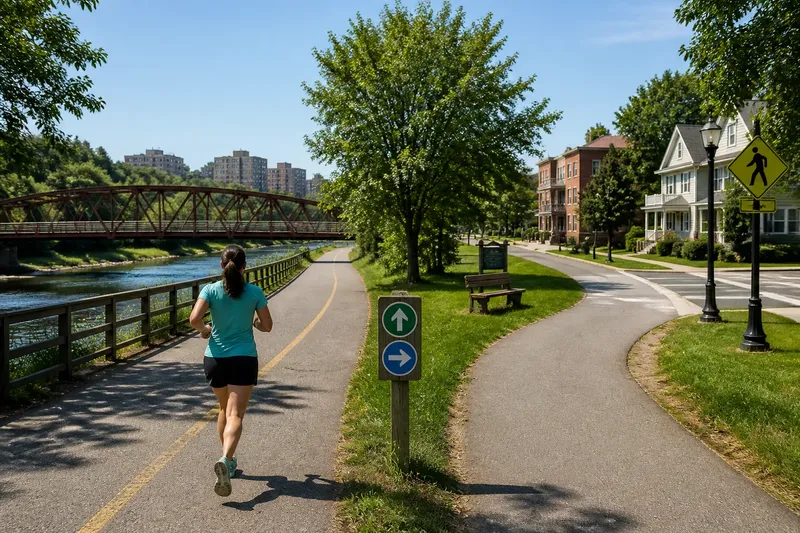
On a loop route, the bakery you passed at the start may appear again near the end, but from the other side of the block. That small change can make a familiar neighborhood feel newly legible. An out-and-back offers a different bargain: you retrace known ground and turn around at a clear point. Choosing between the two shapes not just the map, but what your attention has to do along the way.
Why does a loop route feel less repetitive?
A loop route keeps moving through new surroundings, even when its streets and paths are familiar. A bridge that was ahead of you becomes a landmark behind you; a row of storefronts passes in reverse order. The changing sequence gives the run a sense of unfolding rather than replay.
That novelty can hold attention on an easy run, especially through a quiet park or a neighborhood with a mix of paths and streets. It can also demand more awareness: unfamiliar crossings, trail junctions, and turns require you to look up and make decisions. A loop is not automatically more engaging if the route asks you to check a map every few minutes.
Try choosing one feature to notice in each part of the loop, such as a creek, a line of trees, or the shift from residential streets to a park path. This gives the route shape without turning the run into a navigation exercise.
How does direction change the same route?
Running a loop clockwise instead of counterclockwise changes the order in which you meet its details. A gradual rise might come early in one direction and later in the other; a busy crossing may be easier to approach from a particular sidewalk. Even a familiar path can feel different when the view, slope, or traffic approach changes.
Direction also affects where a route seems to gather effort. If a loop includes a hill, consider whether you would rather meet it while you are fresh or after you have settled into the run. That is a matter of preference and route character, not a promise about how the run will feel.
Before setting off, check the crossings from both approaches if you are deciding between directions. Sidewalk access, sightlines, and the location of a path entrance may make one choice simpler. If a route follows shared paths, stay alert for other users and keep enough room to pass comfortably.
What changes when the return point moves?
On an out-and-back, the turn is a defined moment: reach the bridge, trail marker, or street corner, then head home. That landmark can make the run easy to understand without much navigation. It also means the way back repeats the same ground, including any exposed stretch or crowded crossing.
A loop has no single turnaround. The point where the route bends toward home may be a bridge, a park exit, or simply a junction. Because that return point can feel less obvious, it helps to know which landmark means you are on the homeward part rather than relying on a vague sense of direction.
Imagine you have time for a run around a neighborhood park and want to pass a water fountain before heading home. You could make the fountain the out-and-back turn, so the return is easy to follow, or place it on a loop that continues past the park’s north gate before circling back. In the first plan, the fountain marks the decision to return; in the second, the gate and the next junction also matter. A quick glance at a map before leaving should make the intended route clear.
How should you plan a loop route?
Start with a destination or feature you want the route to include, then connect it to home using streets or paths you can identify. A map app can help trace the shape, but inspect the route itself rather than trusting a line alone. Look for dead ends, trail entrances, construction notices, crossings, and segments without a practical way to continue.
Keep a recognizable landmark near the point where the route begins its return. A library, footbridge, or park gate is easier to remember than an unmarked bend. If you use a running watch or phone map, treat it as a backup to knowing the next turn, not as a reason to run with your eyes fixed on a screen.
- Check the surface: note where pavement changes to gravel or an uneven path, and choose shoes and a route that suit the conditions.
- Review crossings: identify roads that require a full stop or a change in route, rather than assuming the map shows a safe crossing.
- Find an exit: know where you could leave the loop early if weather, footing, or how you feel changes.
- Mark the homeward turn: choose a visible landmark so you can recognize the route’s return section without repeated phone checks.
- Consider the time of day: a path that is easy to see in daylight may have limited lighting later.
When route access, posted signs, or local rules are unclear, follow the on-site guidance and check with the relevant park or local authority.
When is an out-and-back the easier choice?
An out-and-back often suits a run where simplicity matters more than variety. You can choose a clear endpoint, turn there, and return by the route you already know. That can be useful on a new trail, during poor visibility, or when you want to avoid a sequence of unfamiliar junctions.
It can also make route length easier to adjust in the moment: turn around earlier if you need to, or continue to a later landmark if the route and your plans allow. The tradeoff is that the second half repeats the scenery and conditions. If the outgoing section is windy, exposed, or crowded, expect to meet it again from the opposite direction.
For a route with several possible turnarounds, choose a distinctive endpoint before you start. A marked bridge or trail junction gives you a more dependable reference than a guessed distance on a map, particularly where paths curve or signs are sparse.
Which route questions should you ask before leaving?
Is a loop route better for a familiar neighborhood?
It can add variety by changing the order and direction of familiar streets, but only if the turns are easy to follow. If you are still learning the area, keep the loop compact and use obvious landmarks.
What if I get turned around on a loop route?
Pause somewhere safe, check your position against a map, and identify a known street or path rather than guessing at successive turns. If the route remains unclear, retrace a familiar segment or choose a straightforward way back.
Can I run a loop route in either direction?
Often, but crossings, path access, slopes, and sightlines can make one direction more practical. Check both approaches and follow signs or local rules that apply to the route.
How do I make an out-and-back feel less repetitive?
Give the outward and return legs different points of attention, such as noticing landmarks on the way out and the path surface on the way back. The scenery stays the same, but your focus need not.
How do you choose the route for today?
Choose a loop route when you want a changing sequence of places and are comfortable tracking several turns. Choose an out-and-back when a clear endpoint and familiar return matter more. Neither shape is inherently more enjoyable; the useful question is how much navigation and repetition you want on this particular run.
If you are undecided, save one short loop and one simple out-and-back near home, each with a recognizable landmark and an easy way to shorten the run. The next time you head out, pick the map that matches your attention: fresh scenery for a wandering mind, or a known path when you would rather let the route take care of itself.